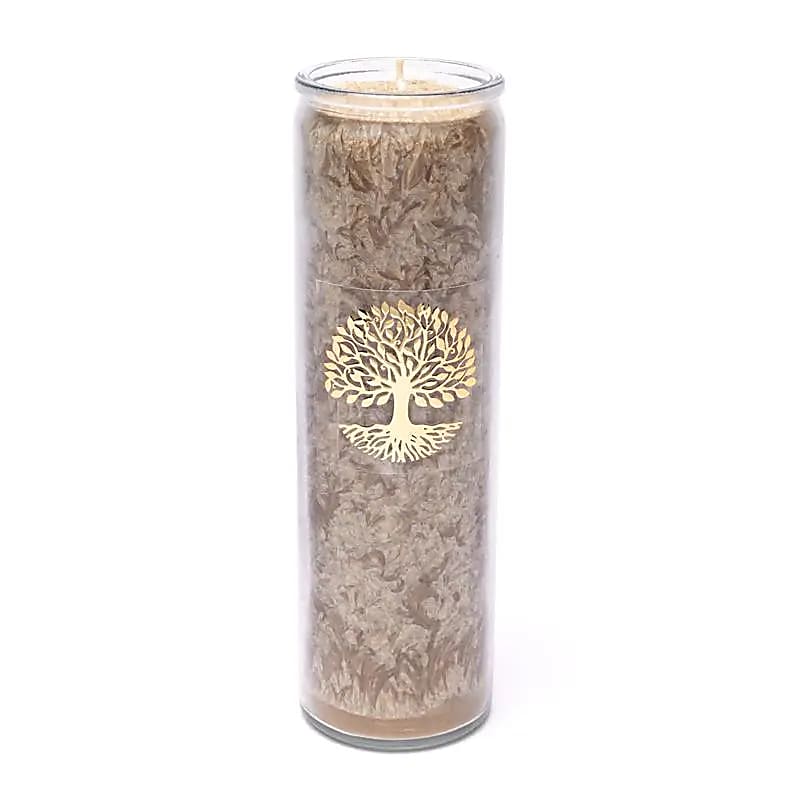
Candle Stearin Tree of Life brown unscented
Candle Stearin Tree of Life brown unscented
Couldn't load pickup availability
Unscented fair trade candle, made from sustainable palm kernel wax (stearin).
Both the candle and the packaging are produced in an environmentally friendly way.
Perfect for rituals, mindfulness practices, or as a spiritual journey through the year or a special cycle.
Tree of Life: Roots and Growth.
Light this to ground yourself. Feel your feet deeply rooted in the earth as your spirit reaches skyward. Reflect on origin, lessons, and legacy. Think: "I grow, I endure, I extend."
About the product
100% natural stearin candle from sustainable cultivation.
In a box made of recycled glass and recycled cardboard.
Burn time: approx. 100 hours.
Cotton wick, stable flame, no smoke.
Includes cork coaster.
Unscented.
Lighting a candle
In many traditions around the world, lighting a candle is a sacred act that means more than words can express; it is about gratitude. People have lit candles in sacred places since time immemorial. Perhaps you, too, would like to begin or end your day with this simple ritual – lighting a candle with mindfulness for yourself and others.
Handmade and fair trade from Indonesia
Made from RSPO-certified palm wax, extracted from the kernel of the palm fruit. A 100% vegetable wax from sustainable agriculture. Low smoke, with cotton wick.
Handmade in Indonesia by a WFTO-certified fair trade company that provides work for as many people as possible. Approximately eighty percent of the employees are women. The packaging is made from recycled paper and the candle is poured into recycled glass.
Instructions for use
For the best burning performance, do not just light briefly but let it burn longer.
Do not burn for more than 4 hours at a time.
Trim the wick to 0.5 cm (¼") each time the candle is lit.
Do not use the candle when 1.3 cm (½") of wax remains at the bottom.
Caution!
Keep out of reach of children and pets.
Do not place in a drafty location, as this will shorten the burn time.
Do not leave a burning candle unattended.
Always place on a heat-resistant surface.
The Tree of Life in various religions and spiritual traditions
The Tree of Life is a powerful symbol that has existed in various religious and spiritual traditions worldwide for centuries.
Tree of Life, ancient Iran
In Iranian mythology, there are several sacred plant icons that relate to life, healing, and eternity. Like the guardian of plants, goddess of trees and immortality.
Tree of Life, ancient Mesopotamia
The Assyrian Tree of Life was depicted by a series of knots and intersecting lines. However, the name "Tree of Life" is the modern name, not used in Assyrian times.
Tree of Life, Baha'i Faith
The concept of the Tree of Life appears in the writings of the Baháʼí Faith, where it may refer to the Manifestation of God, a great teacher who appears to humanity from time to time.
Tree of Life, Buddhism
According to Buddhist tradition, the Bodhi or Bo tree is the tree (Ficus religiosa) under which Buddha sat when he attained enlightenment about 2,500 years ago in Bodh Gaya, India.
Tree of Life, China
In Chinese mythology, a tree of life is often depicted in combination with a phoenix and a dragon, with the dragon often representing immortality. A Taoist story tells of a tree that produces a peach of immortality every three thousand years, and anyone who eats this fruit becomes immortal.
Tree of Life, Europe
Antoine-Joseph Pernety, a famous 18th-century writer and alchemist, identified the Tree of Life with the elixir of life and the philosopher's stone.
Tree of Life, Germanic Paganism and Norse Mythology
In Germanic paganism, trees play a prominent role and appear in various aspects in traditional texts and even in the names of Germanic gods. The Tree of Life appears in Norse religion as Yggdrasil, the world tree that spans 9 realms and contains the 3 magical springs of all life: the spring of wisdom and knowledge, the spring of past, present, and future, and the spring of space, the cosmos itself.
Tree of Life, Islam
Trees also play an important role in the Quran. The date palm is mentioned about 20 times and is described as originating from paradise and healing. It is the tree under which Mary – according to Allah – gave birth to Jesus. About the olive tree, it is written: "He showed the pure river of the water of life, clear as crystal, flowing from the throne of the Lamb of God. In the middle of the street and on either side of the river was the tree of life, which bore twelve crops of fruit, yielding its fruit every month. And the leaves of the tree were for the healing of the nations."
Tree of Life, Mesoamerica - the Maya culture
Among the Maya, the central World Tree was conceptualized or represented by the Ceiba tree. It represents the Axis Mundi, the stable center of the universe.
Tree of Life, Judaism
The Tree of Life is mentioned in the Book of Genesis. The most well-known tree in the Garden of Eden is the Tree of Knowledge of Good and Evil, from which Adam and Eve ate, resulting in their expulsion from Paradise. Judaism also mentions the Tree of Life or the Tree of Souls. This tree produces souls and thus life itself.
Tree of Life, Native Americans
The motif of the Tree of Life is firmly rooted in Native American traditions, including Ojibway cosmology. The Tree of Life represents everything that lives on this planet and in the universe. It "beats" the rhythm of life, day by day, year by year, life by life. Native Americans highly value all living things and are masters at maintaining the balance between their own needs and what nature provides.
 High Quality
Low stock: 2 left